|
First Mauritius PCC Limited: Key Features Document Key Features Documentation is not required with respect to investments in protected cell companies. First Mauritius PCC, however, is providing information in a format similar to a Key Features Document to the professional advisers of the clients. It is up to these advisers to decide what information is pertinent to pass on to their own clients. The Protected Cell Company and its Operation Legislation enabling the formation of protected cell companies ("PCCs") came into effect in Mauritius on 1st January, 2000. The legislation, in the form of the Protected Cell Companies Act 1999 ("the PCC Act") is a relatively exceptional piece of legislation. The only other jurisdictions where similar legislation has been enacted are Guernsey, Bermuda and the Cayman Islands.
In Mauritius, a PCC may be easily differentiated from a non-PCC in that, by law, there must be included within the name of the company either the letters ‘PCC’ or the words ‘Protected Cell Company’. A PCC is single legal entity which operates in two distinct parts. These distinct parts are the Core and the Cells. There is (and must only be) one Core; but there may be an infinite number of Cells. 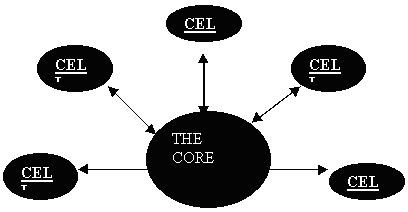
A PCC will generally have two classes of shares:
Cellular shares are issued, as required, under different names or numbers so as to identify, and to represent, the particular Cells to which they are attributable. For example, ‘Christopher Robin cellular shares’ will be issued with respect to Christopher Robin’s Cell and ‘Christopher Wren cellular shares’ will be issued with respect to Christopher Wren’s Cell; and so on and so forth. Alternatively, each Cell may be given an identifying number, rather than a name. As the Mauritius Regulator does not require First Mauritius to identify to the Regulator the names of the cellular shareholders, anonymity is available. This connection between named cellular shares/identifying numbered cellular shares, and the Cells to which each is attributable, is enshrined in the Memorandum and Articles of Association of each PCC and is mandated by the PCC Act. Once a Cell has been created in consequence of a creation and issue of cellular shares, all assets of (including profits and reserves), and all matters and acts relating to, that Cell must, by law, be identified by the Cell name (or number, if applicable). For example, separate accounting must be conducted and recorded with respect to each Cell, and each Cell’s assets must, at all times, be separately ascertainable and identifiable - as assets distinct from the assets of other Cells, and the assets of the PCC itself (the Core assets). Under the PCC Act, the assets of each individual Cell are attributable to that Cell alone; and to no other or others. By law, creditors of one Cell have no recourse to the assets of any other Cell. By law, creditors of a Cell may, in certain limited circumstances, have recourse to assets held within the Core; that is to say, the Core assets. The Core assets (which will normally be minimal relative to Cell assets) are themselves separately identified in order that there can be no confusion as which assets are Core assets, and which are not. The Board of Directors of the PCC is appointed by the Core shareholders. The Cell shareholders have no management or control role or function with respect to the PCC, its business or its affairs. The United Kingdom Context (as an example) In the United Kingdom, as in most other relevant jurisdictions, corporate bodies are normally established either: (a) as limited liability companies (limited by shares or by guarantee); or (b) as unlimited liability companies. Each form of company has a separate and identifiable legal persona. It is a metaphysical entity or a fiction of law, with legal but no physical existence. However, in that each form of company has its own legal personality, it may contract with third parties; it may issue shares; raise finance; and trade; etc. In the United Kingdom, for example, it is possible for a company to create and issue different classes of shares, and for its Articles of Association to restrict and/or differentiate the rights of shareholders, between and amongst them; for example, with respect to preferential or deferred rights as to dividends or capital. It is also possible, therefore, to form a company in the United Kingdom with a share capital divided into "A" class shares, "B" class shares, "C" class shares, and so on. The company’s Articles could then prescribe that the holders of the "A" class shares are to be entitled only to the net profits from the company’s activities in venture "A"; that the holders of the "B" class shares are to be entitled only to the net profits of the company’s activities from venture "B"; and so on and so forth. The foregoing, of course, is no more than the position between and amongst the various classes of shareholders; and between and amongst the shareholders and the company. However, it is a fact of life (and law) that - insofar as third parties are concerned - such arrangements/agreements between and amongst the shareholders (on the one hand), and between and amongst the shareholders and the company (on the other hand), do not affect the rights of, say, third party creditors, as against the totality of the assets of the company. The contrast, then, between a company incorporated under, say, United Kingdom law, and a company incorporated under the PCC Act, is that, in the latter case, a third party creditor – by statutory enactment – is effectively limited in remedy to those assets which are attributable to the particular cell in relation to which the creditor has dealt. Under the PCC Act, therefore, the legislation has enabled the company, and its shareholders, to enjoy an "A", "B", "C" class shareholding structure which binds third parties as well as the company’s shareholders, between and amongst themselves, and the shareholders and the company, again between and amongst themselves. In consequence, under the PCC Act an individual (or other entity) can invest in relation to a single Cell in the PCC and enjoy the specific rights over that Cell and the assets and liabilities attributable to the Cell – all whilst being only one of many shareholders in the company. In further consequence, the same individual (or other entity) possesses the comfort of knowing that should the PCC, in attribution relationship with a particular Cell, become a net debtor (an unlikely event in the case of a PCC engaged in offshore investment funds), the remedy of the creditors of the PCC, in attribution relationship with that net debtor Cell, are restricted in remedy against the net debtor Cell, and no other Cell. First Mauritius: Shareholding Structure First Mauritius is a protected cell company incorporated pursuant to the PCC Act. It is subject to licensing supervision by the Mauritius Offshore Business Activities Authority ("the Mauritius Regulator"). For information on this Mauritius Government Authority, you are invited to visit the website www.mobaa.net. Presently, First Mauritius has one core shareholder, namely, Corporate & Chancery Group (Asia) Limited ("C&C Asia"). C&C Asia holds 1,000 US$1 ordinary class shares in the capital of First Mauritius. These shares comprise the Core assets of First Mauritius. Cellular shares have already been created and issued to investors. C&C Asia itself has two shareholders, namely, Corporate & Chancery Group Limited ("Corporate & Chancery") and Corporate & Chancery Nominees Limited. Corporate & Chancery is a Mauritius licensed management and trust company and is, like First Mauritius, subject to licensing supervision by the Mauritius Regulator. Corporate & Chancery Nominees Limited is wholly-owned by Corporate & Chancery. The sole director of Core Holdings is Corporate & Chancery. For further details on Corporate & Chancery, you are invited to visit the website www.chancerygroup.net . First Mauritius: Directors The directors of First Mauritius are four individuals resident in Mauritius. These four individuals were appointed directors of First Mauritius pursuant to an engagement contract between First Mauritius and Corporate & Chancery ("the Engagement Contract"). First Mauritius: Residence The present four individuals who are the directors of First Mauritius, and who are resident in Mauritius, will solely exercise the effective, day-to-day, management of First Mauritius, and they will also hold, exercise and retain central control and management of the company. First Mauritius will have no agency, place of management, seat of business, central administration, head office or anything of a similar nature, whether fixed or otherwise, save and except in Mauritius. In the particular, First Mauritius, is a company liable to taxation in Mauritius (but at an effective "pioneer status" rate) in consequence of: (a) the fact of its incorporation in Mauritius; and (b) the fact that its central management and control is in Mauritius. As such, First Mauritius is a "resident of Mauritius" within the meaning of Article 4(1) of the Convention between the United Kingdom and Mauritius for the avoidance of double taxation ("the UK/Mauritius Double Taxation Agreement"). First Mauritius is similarly advantaged in terms of the other 25 worldwide Double Taxation Agreements to which Mauritius is a party. First Mauritius: Engagement Contract With Corporate & Chancery As noted earlier, First Mauritius entered into an Engagement Contract with Corporate & Chancery. Under this Engagement Contract, Corporate & Chancery agreed to administer and manage First Mauritius. Further under the Engagement Contract, Corporate & Chancery undertook to ensure that First Mauritius will comply with, in every respect, the terms of the PCC Act; and to establish an infrastructure which will enable the operations of First Mauritius to be conducted efficiently, securely and transparently. In the foregoing regards, Corporate & Chancery agreed to deal with the following matters, amongst others (and not necessarily in this order):
In consideration of Corporate & Chancery undertaking the foregoing duties and obligations under the Engagement Contract, First Mauritius agreed to pay Corporate & Chancery fees, payable annually in advance, equal to (roughly) a percentage of the fees which First Mauritius, in turn, will charge each cellular shareholder. Finally, in terms of the Engagement Contract, for obvious potential conflict of interests’ purposes, Corporate & Chancery, its directors and shareholders covenanted not to invest, whether directly or indirectly, in relation to any Cells in First Mauritius. First Mauritius: Typical Investor Profile The promotion of First Mauritius will be conducted through regulated professional investment advisers, usually at institutional level. There will be no direct contact with, or other solicitation of, investors by First Mauritius (which, for these purposes, includes, Corporate & Chancery, its directors and shareholders, and likewise with C&C Asia). In addition to the normal forms of investment in which investors become involved, what First Mauritius will be offering these professional investment advisers is, essentially, a structure which will allow their respective clients potential access to investments which were previously unavailable to them. For example, First Mauritius will provide information on, and access to, PEFIs, etc. The concept behind PEFIs is that many client investors would like to invest a relatively small percentage of their overall wealth/investments in more speculative ventures. As most professional investment advisers are aware, whilst considerable profits are made when companies are floated, the real profits are made prior thereto. It is this anterior opportunity that First Mauritius can make available to investors. In the foregoing regards, it is to be noted that the companies which promote PEFIs and like investment opportunities tend only to accept investments from larger investors. The definition, so to speak, of a "larger investor" tends to be someone who is able to invest US$1 million upwards without, at the same time, investing more than 10% of his wealth. A few promoters of PEFIs and like investment opportunities will occasionally accept a lesser investment, say, US$500,000, but will still not accept that lesser sum if it exceeds 10% of the investor’s wealth. In consequence, the market is a restricted one. However, in the case of a PCC like First Mauritius, the promoters of PEFIs and like investment opportunities will view the company as a single investor and thus accept what is an aggregated investment. They will do this because the acceptance of the aggregated investment (coming from a single legal person – First Mauritius) will not adversely affect either their administration or some of the more complicated marketing rules which surround the limit as to the total number of investors who are permitted to invest in a pre-IPO or similar investment oriented company. Additionally, many promoters of PEFIs and like investment opportunities waive placement fees where the investment is in a substantial sum, for example, US$2 million and upwards. The ability of the PCC to commit, in appropriate cases, an investment of such a sum means a saving to the cellular shareholders involved of up to 3% of their respective investments. This means, of course, an effective higher net return on the investments. Clearly, then, individual investors (cellular shareholders) – via First Mauritius – will have available to them opportunities to invest, together with other cellular shareholders, in potentially high profit PEFIs and like investment opportunities. Such opportunities are not likely to be otherwise available to them. In addition, even if an investment in PEFIs, etc. is perceived to be at the higher end of the investment risk spectrum, the individual cellular shareholder: (a) is investing less money than he would if he were an individual investor in PEFIs, etc.; and (b) he still has the protection of the protected cell companies legislation (in relation to his other cellular assets) should financial disaster strike another or other Cells in First Mauritius. In the event, however, it is the very fact that an individual, through First Mauritius, can avail himself of high gain returns not otherwise available to him - as an individual investor - which First Mauritius believes will attract the serious attention of professional investment advisers. For clarity, the jurisdictions relating to PEFIs, etc. which First Mauritius will be drawing to the attention of professional investment advisers will be the United States, Europe (including the United Kingdom), India and the Far East. The other motivating factor which will attract investors to First Mauritius is, as mentioned elsewhere herein, the cellular protection offered by the PCC Act which, when coupled with the lower administration costs afforded by an "umbrella" structure, means a greater net return on investments. However, it is the "coupling" of this cellular protection with reduced costs which will motivate investors. This can be clearly seen by reference to fund promotion business in other jurisdictions. Gibraltar has just introduced what its Financial Services Commission describes as an "Universal Master Fund – Special Purpose Vehicle" ("the UMF"). This umbrella structure is designed to allow sub-funds to join a Commission approved UMF in circumstances where administration costs are reduced and regulatory requirements eased (because the "umbrella" UMF is already a Gibraltar Financial Services Commission approved entity). However, the Gibraltar UMF is unable – unlike First Mauritius – to provide the "coupled" cellular protection for individual fund investors whilst, at the same time, affording reduced administrative costs and lessened regulatory compliance. It is unable to do so because Gibraltar has no legislation similar to the PCC Act. Even the Gibraltar Financial Services Commission has had to concede that investments in which UMF funds may participate must not be investments (like PEFIs) where a sub-fund "may fall into a deficit situation, as this might prejudice the independent status of [other] sub-funds." In other words, the Gibraltar Financial Services Commission itself acknowledges the weakness – and lack of commercial competitive edge – which the UMF has as against, for example, First Mauritius. It is for this reason, amongst others, that First Mauritius can provide to investors a safe-haven structure which: (a) maximises net returns through, amongst other things, reduced administration costs; (b) affords individual protection of investments in relation to other cellular investors and their investment decisions; and (c) permits individual investors to choose their own cell fund manager or managers. In the event, therefore, it is the intention of First Mauritius to promote the First Mauritius structure solely as one which will: (a) afford investors higher-return opportunities not otherwise available to them (for example, PEFIs); (b) at reduced administration costs and individual regulatory compliance; (c) with both of the foregoing being afforded in the investment security environment of cellular protection; and (d) in an environment of investor-choice fund manager/s.
|